On a hot, sunny spring day of May 31, 1985 people didn’t yet know what Mother
Nature would bring. By evening people saw a different world. At 7:45 pm an F4 tornado
with 250 mph winds took two minutes to slam through Parker Dam State Park. The
Moshannon Tornado originally touched down around 7:30 pm near Winterburn,
Clearfield County, PA. It crossed Clearfield, Cameron, Centre, Clinton, and Lycoming
Counties in a matter of 90 minutes, wrecking 26,000 acres, and bringing about millions
of dollars of damage. It was one of a larger outbreak which overall caused $600 million
in damages. That would be equal to over $1.72 billion in 2025. Twenty-one tornadoes
touched down in Pennsylvania that day. It is still considered the deadliest outbreak in
Pennsylvania history and the third deadliest in the entire United States. In Clearfield
County one person was injured and 13 homes were ruined.
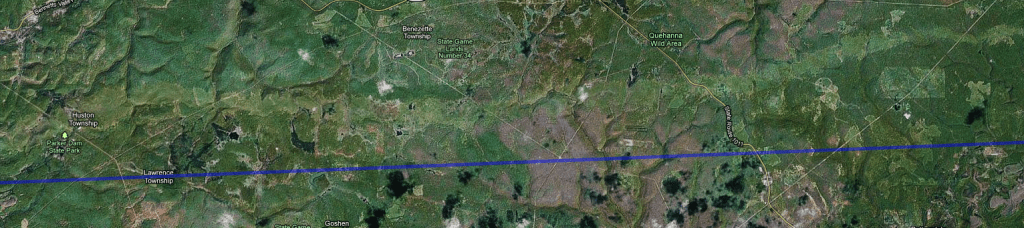
In the State Park itself the tornado was 300 yards to 1.5 miles wide and mangled buildings, 25 camps (23 damaged, 2 destroyed), and 500 acres of land. It was at its widest of 2.57 miles in
Centre County.

In 1950 the National Oceanic and Atmospheric Administration (NOAA) started to
record tornado data. There have been eight tornadoes in Clearfield County,
Pennsylvania since then. They occurred in 1954, 1976, 1985, 1994, 1996, 1998, 2001,
and 2009. I was also able to find information on a tornado in 1919 in Glen Richey,
Clearfield County and in 1945 in Rockton, Clearfield County.
The Clearfield Progress ran an article on August 22, 1919 that reported two
funnel clouds in Glen Richey traveled 1.5 miles on August 21 st at 8:00 pm. It explained
that three houses were smashed and other houses, barns, sheds, orchards, and grain
were damaged. A woman was burned when she and her cookstove fell into her cellar.
The Courier Express reported that on September 14, 1945 a tornado happened
in Rockton at 4:55 pm and cut a path 400 feet wide. It damaged several farms, a
church, powerlines, and phone lines. Roads were blocked. People who witnessed the
tornado heard it coming and thought they saw crows, but it was really the debris from
the tornado. One farm in particular called the Hallopeter Poultry Farm experienced the
loss of most of their chickens and their two-story barn was destroyed. One man was in
the basement and got minor injuries. A descendant of the family, Doreen Snyder, told
me that the family had stopped paying for tornado insurance a few years earlier, but
they rebuilt the chicken building to one-story with the same basement. They abandoned
their incubator service. At another farm, a man was in an outhouse when the tornado hit
and they were taken up into the air.
Not all thunderstorms produce tornadoes. In order for tornadoes to form there
have to be certain things happening in the atmosphere. Wind shear, which means winds
change speed, directions, or both with height, must be present. When winds are moving
different directions, this can cause horizontal rotation.

Moist, warm air near the ground moving one direction begins to rise because warm air is less dense than the cooler air above it. As the air rises, it encounters winds moving at different speeds and directions.
This upward movement is called an updraft and it causes the already present horizontal
rotation to become a vertical rotation. This can eventually form supercell thunderstorms
which have the potential to create severe tornadoes.
I met up with a meteorologist whose name was Henry Margusity and he shared
some facts about tornadoes and the 1985 tornado outbreak.
During the 1980’s, in order to warn people or talk about what had just happened,
they would rely on the TV or radio. If you didn’t have the TV or radio on, then you
wouldn’t know. Today most people carry cell phones with them all the time and have
access to alerts, weather apps, texting, and social media to warn them about severe
weather conditions. People would be talking about the potential for tornadoes days in
advance on social media today.
In 1985 meteorologists used the following tools: soundings (weather balloons
that measured temperature, humidity, and wind at different heights), computer models
(LFM and LGM), surface maps, and non-Doppler radar. Today we have Doppler radar
that shows rotation, satellites, and more advanced computer models which do a lot of
the work for us. All of these allow more accurate forecasting.
In Pennsylvania we have geographic features that often slow tornadoes down. In
states like Oklahoma or Kansas the ground is more flat and they get warm, moist air
from the Gulf of Mexico. It once was true that tornadoes were less common in PA than
Midwest states, but that isn’t true anymore. We’re not quite sure why tornado alley might
be shifting eastward.
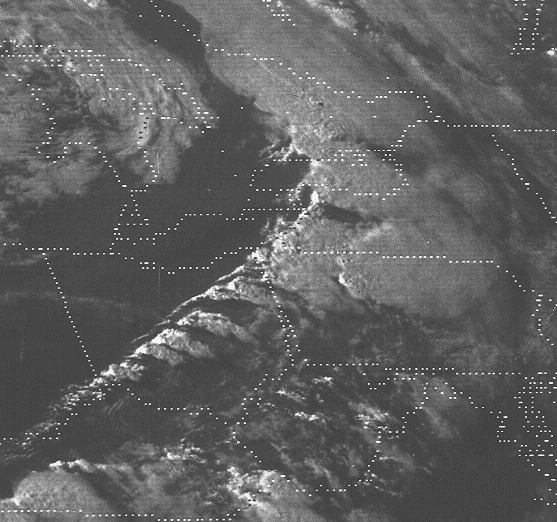
Strong tornadoes greater than an F2 are rare in this area of Pennsylvania. In
Pennsylvania tornadoes can occur anytime, but June to July are the most common
months to see one. Tornadoes happen as much in other countries as they do in the U.S.
In the five days leading up to the Moshannon Tornado, meteorologists forecasted
the possibility of tornadoes. It was pretty unique to forecast a whole swarm of
tornadoes.
It was very sunny and warm that day. The meteorologists thought maybe they got
it wrong, but they started to see a storm in Cleveland which became the tornado that
touched down at Parker Dam. The dry air was capping the warm, humid air underneath.
As soon as the cap was forced off, then there was an explosion of storms. Instead of
creating a squall line with strong winds or possibly one or two tornadoes, it created
numerous individual supercell thunderstorms, each capable of producing their own
strong tornadoes. In fact, we had 43 tornadoes across Ohio, Pennsylvania, New York,
and Ontario, Canada that day.
The meteorologists were gathered with colleagues at a get-together. When they
saw the severe weather showing up, they all rushed to the Penn State radar room. The
radar system blew up from the heat of everyone’s body in the room!
After the tornado, Mr. Margusity drove down the Quehanna Highway and started
to see branches down. As he kept on going there were trees twisted and mutilated. The
smell of sap in the air was overpowering. Mr. Margusity reported that he has found
evidence of tornadoes that no one even knew about when he has been out in the
woods. He even was chasing one in Woodland once near the I-80 exit which is only one
mile from my house.
Although some people did not think tornadoes could climb mountains, Mr.
Margusity said that scientists have known they indeed could. The Parker Dam tornado
crossed ridges 1,500-2,000 feet tall. The Moshannon Tornado was one of the widest
recorded in the United States. The path of destruction was fairly wide because the meso
part of the tornado was on the ground. It was a wedge tornado which appears wider
than tall. If the tornado had been further south the towns of Clearfield and Philipsburg
would have been destroyed.
The students graduating at the high school could see the tornado as a big wall of
blackness. People driving on I-80 and those living in Clearfield and Philipsburg could
see it and probably heard it, too.
The Deike Building at Penn State houses the College of Earth and Mineral
Sciences. In that building there is a seismograph which usually measures the vibrations
in the ground of things like volcanoes and earthquakes. It was reported that this
seismograph recorded seismic waves the day of the tornado that were a result of the
vibration of the trees falling.
Debra Archer was working as a dispatcher at County Control. It was located in
the basement of Mountain Laurel Nursing Home. It had no windows, so she couldn’t see
what was going on outside. There were calls coming in on every single line. The State
Police in Bradford Township (Woodland) called to tell them that the nuclear reactor in
Quehanna was hit. They didn’t know what to say about this.
In 1955 the nuclear reactor was installed by the Curtiss-Wright Corporation to
make jet engines. While in 1985 it was used by PermaGrain products to make flooring.
Even though it was hit, there was no leak.
At the Lady Jane Mine in Penfield a man named Larry Graham witnessed the
tornado suck up an entire pond—leaving it completely dry. Tornadoes can pull frogs and
fish out of ponds then put them down farther away.
On the day of the tornado, there was going to be a Boy Scout weekend campout.
They planned to set up tents, but it was calling for thunderstorms so the adults asked to
get the key to the cabin classroom which was built by the CCC (Civilian Conservation
Corps) in the winter of 1935-1936.
There were five total people there t the time the tornado hit—Ken Hunt, his
brother (Jim), his father (Howard), Marty (the other Boy Scout leader), and Sam (Marty’s
son). Ken had no idea what was going on. He was on the front porch talking to his dad
and to the other leader. The other boys were inside listening to a Ghostbuster’s tape.
When the tornado came, everyone met at the doorway and they were trying to hold the
door shut.
Ken reported to me that it sounded like a very loud freight train coming through
the area. You could see flashes of light on the hill where the powerlines ran as the
transformers blew. Marty thought it was a plane crashing. The sky looked green. It has
to do with an angled sun and debris in the air.
Ken was lifted up by the winds and left flapping like clothes on a clothesline while
the two adults were holding his hands so he wouldn’t blow away. He described it as a
sensation of weightlessness. A brick from the fireplace hit Ken’s brother’s leg and his
hat blew away. The two minutes seemed like forever to Marty.
Ken stated he didn’t know what tornadoes were and didn’t know what to think of
the whole thing. He was only seven at the time. He also mentioned it was just so fast to
him. Like everyone else, he was speechless and shocked.
As they were looking around afterwards, they saw a part of the chimney had
broken off, part of the roof was torn off, and a crutch had blown on top of the roof from
somewhere else. However, the fire was still burning in the fireplace.
Before the tornado happened, you couldn’t see the cabin from the road with all
the trees blocking it from view. After the tornado damage, you could see it fully from the
road and still can today.
The tornado actually came after the thunderstorm and was followed by more rain.
Although Marty and Sam stayed the night, Ken wanted to go home. Another dad, Mr.
Hoyt, who was supposed to join them, came to check on them. He had to park his
vehicle and walk through downed trees on the road to reach them. Howard’s truck was
in poor condition. The winds forced it against the cabin and a tree went through the
driver’s door. All the windows got shattered from the pressure of the wind and the inside
was filled with leaves from the trees. The leaves were crunchy like fall leaves. The
insurance company actually fixed the truck and he continued to drive it for years, but
that night they walked back in the rain, over and under trees and downed lines to catch
a ride home with Mr. Hoyt.
“Why are y’all home?!” his mom said when they walked in the door. She was in
bed with strep throat and she couldn’t believe them at all when they told her what had
happened.
People guessed that the reason why the cabin mostly survived was because it
was eight sided. Others believed it had to do with the trees guarding and protecting it.
“Everyone was just amazed that we survived the storm,” Ken said. Howard had
to go to the hospital the next day after the tornado for treatment of debris from the
tornado in his eye.
For a while after the tornado when there was a thunderstorm, Ken wanted to
sleep downstairs.
That tornado destroyed most every tree there was around the cabin. In order to
clear the road they had to use chain saws. On one side of Mud Run Road the trees
were cut into timber while on the other side they let the trees alone to watch what
happens in nature after a tornado. The timber that was salvaged was worth over two
million dollars. Eventually 600 trees were planted to replace those originally planted by
the CCC.
There once was a trail called the Trail of Giants. After this part was destroyed by
the tornado, it was renamed the Trail of the New Giants. New generations of trees
would grow up to be giants themselves.
You could still see the path the tornado made in 2005 on Google Earth. Eric
Rensel, Natural Resource Program Specialist, explained that you can still see evidence
of the tornado today 41 years later. When a tree falls its roots pull up soil with it and it
leaves a pit. Then as the tree decays the dirt falls off the roots and makes a mound of
dirt. This fascinated me the most. We can even determine which way the wind blew the
tree down based on where the pit is in relationship to the mound.
When comparing the logged to the unlogged area it is important to understand
several things. First, most of the area hit by the tornado was not an old-growth forest
(150+ years). It had been logged in the late 1800’s to the early 1900’s, so it would have
been considered a mid-aged or mature forest when the tornado hit. The forest is
changing all the time. Second, foresters talk about timber harvesting mimicking natural
disturbances because they both create openings in the canopy, but there is a difference
between planned timber harvesting and salvage logging. In salvage logging foresters
remove certain already damaged or dangerous trees. In a planned timber harvest they
can choose each tree to harvest and which to keep. Although there was not any study
or long-term analysis of the tornado area, it is possible to say that the succession of the
logged versus unlogged areas had a different make up and density of trees and other
plants.
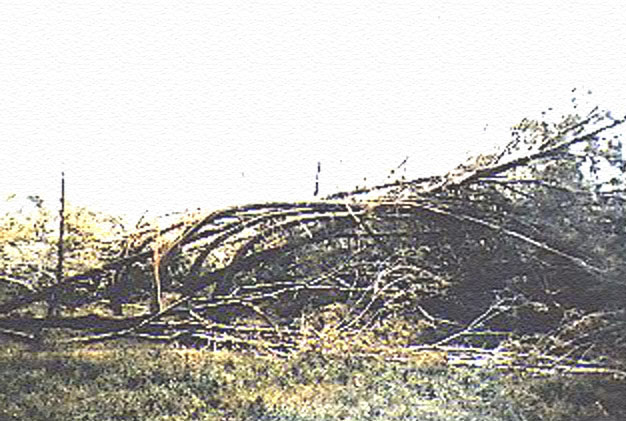
In the unlogged area where the tornado hit, what we see growing is black birch,
black cherry, and red maple. There are also a few red oak and aspen. Over time, black
cherry and black birch will die off and become a forest of mostly oaks and maples.
You mostly see invasive plants near the roadside and outside part of the forest
more than the inside part of it. Zak Miller, forester with the PA Department of
Conservation of Natural Resources, explained to me that when he was walking around
in that forest, he spotted Autumn Olive and Japanese Barberry and this forest was not
getting damaged too much by these non-native plants.
When Mr. Miller talked to people who worked there in 1985, they always said it
took months to set up timber sales, to clean up the roads, and to tidy up the aftermath.
He added that, “The devastation was unbelievable and the scars on the landscape will
be evident for decades to come.”
This tornado was pretty devastating and rare. The different people I talked to
shared their own bits and pieces of memories and facts. If I had lived through this, I
would have been totally terrified.
Sharing Clearfield County’s history is important and this rare and powerful
tornado shows that even Clearfield, Pennsylvania can and does experience dangerous
weather. By hearing the real stories of people who went through this tornado we can
imagine what it must have been like as if we were really there. We learned how
tornadoes form and how important winds and rotation are to their formation. The
tornado changed the land and the habitat for the animals and insects who called the
Moshannon State Forest their home, it left a trail of everlasting memories in the minds
of those who lived through it, and it left us with an inspiration to take future tornado
warnings seriously.
Sources
- Interview with Ken Hunt, tornado survivor
- Interview with Henry Margusity, Meterologist, and PowerPoint Presentation
- Email with Eric Rensel (DCNR Natural Resource Program Specialist)
- Email and attachments from Brian Salvato and Zak Miller (DCNR Foresters)
- Facebook Messenger interview with Doreen Snyder
- Facebook Messenger Interview with Debra Archer
- History of Clearfield County Facebook Page
- Clearfield County PA Genealogy Facebook Page
- Sign at Parker Dam State Park
- “Tornado Outbreak of 31 May 1985” by Kevin Fitzgerald and Richard Grumm,
National Weather Service State College, PA 16803.
- Moshannon State Forest Tornado 25 th Anniversary YouTube Videos
- “May 31, 1985 Tornado Outbreak: 35 th Anniversary”
http://www.weather.gov/ctp/TornadoOutbreak_May311985
- “May 31st 1985 Tornado Outbreak: Remembering one of the deadliest
tornado outbreaks in U.S. history 40 years later”
https://storymaps.arcgis.com/stories/e8c12f670d5648a9b64877f42660eeeb
- NOAA National Centers for Environmental Information National Oceanic and
Atmospheric Administration website.
- “Parker Dam State Park-Moshannon State Forest, PA F4 Tornado—May 31,
1985” by Nick Wilkes on October 22, 2024 (www.tornadotalk.com/parker-
dam-state-park-moshannon-state-forest-pa-f4-tornado-may-31-1985/
- Gant Daily article by Jessica Shirey, May 31, 2015, “Survivors Remember
Parker Dam Tornado 30 Years Later.”
- The Progress article by Marian Fahr, June 3, 1985, “Progressland Tornado
Loss Put at $12 Million.”
- The Progress article by Marian Fahr, “May 31, 1985: A Night They Will Never
Forget.”
- The Clearfield Progress article, August 22, 1919 (p.1,3) regarding Glen
Richey Tornado.
- The Courier Express article, September 14, 1945, “Rockton Has Heavy Loss
In Flash Tornado.”
Written by Danika Yingling